Tuesday, June 9, 2020

A Son of the West Fork Has Passed

In 2009, I wrote several blog posts about the Barkers Mill area of southeast Christian County, KY. I did a little study of the pioneer history along the West Fork River, and I became very interested in it. I spent several pleasant afternoons, touring and photographing the beautiful farmland, Chapel Hill church, big old houses, and other sights of the area. Some of those photos ended up on my blog along with what I wrote.
Chapel Hill church in Christian County, KY
Chapel Hill Church

West Fork River from Barkers Mill Bridge
Not long after I published those posts, I received an email from a fellow who introduced himself as Will Meriwether. Born in 1923, he had grown up in the West Fork area, just over the state line in Montgomery County, Tennessee. He had enjoyed reading my posts. He was descended from some of the earliest settlers of the area-- among them, the Barkers and (of course) the Meriwethers. One of my photos, taken from the Barker's Mill bridge, looked over an area where he and his brother and friends used to swim -- a happy memory from his youth. He went away to college as a young man and became a doctor. Life took him around the world and back, but he still loved his childhood home. I heard from Dr. Meriwether occasionally through the next decade. One of his earliest memories was a visit to a cotton gin in Hopkinsville with his father. He wondered if he remembered that correctly. I sent him an old newspaper column where the writer mused about former times when cotton was grown in Christian County and ginned in Hopkinsville. This was the sort of thing our conversations were about. A year ago, Dr. Meriwether sent several old photos and drawings of historic homes in the West Fork area that he thought I would enjoy seeing. A few weeks ago, he wrote to me, asking if I had a recent photo of Glenburnie, an old home that was built by a Barker patriarch in southern Christian County. He was trying to help a descendant of a Glenburnie slave of Chiles Barker, who was gathering material for his ancestral history. (I did not have a photo, but I encouraged him to contact Jim Coursie, a local architect and writer, who takes a great interest in the historic houses of this area.) A few days ago. I learned that Dr. Meriwether passed away shortly after our last email exchange. One of his daughters wrote to me about it. I was truly shocked. William happened to be born into a family that probably had more affluence and influence (historically, anyhow,) than many of us enjoy, but he didn't coast through life on his family credentials. He made his own way with his hard work and good mind and his gift for outreach. I want to mark his passing, and so I am sharing his obituary which tells some of the highlights of his interesting and noteworthy life. I hope you will find it inspiring. https://www.dignitymemorial.com/obituaries/san-antonio-tx/william-meriwether-9198053 Condolences should be offered to the family, not to me. I will miss hearing from Dr. Meriwether, but I was acquainted with him only through our email correspondence.

Friday, May 29, 2020

Add Zip Tie "Boning" to a Face Mask

First, let me say that full credit for the amazing, wonderful idea of a ziptie boning goes to Renée Thompson McCloud.  Please see her videos on YouTube

The purpose of the zip-tie boning is to keep the fabric and center seam of the face mask arched so the mask will not collapse toward the nose and mouth as you breathe.

I was so excited when I read about a ziptie boning in a mask! I joined Renée's Facebook group, Zippy Mask Support, and, after some study there, I tried putting the ziptie in the front seam allowance (as many Zippie maskmakers do.) That didn't go well for me, but I was determined. I decided I could make a casing for the boning down the center seam, instead.

When I posted a photo of a mask I had made with the ziptie in a casing, several people asked me to do a video. That would be a steep learning curve for me. It was easier to just make this tutorial.  

I attach the boning to the lining of the mask only. If the boning holds the lining back from the face, it will also hold the front of the mask away from the face. There is no need to sew it through both layers.

Here is how I make the casing for the ziptie.

On one of the two lining pieces, baste a line from top to bottom along the front edge of the face mask.  Use a long stitch for the basting so it will be easy to pull out later.


With rights sides together, sew the center seam of the lining with 1/4" seam allowance. Below, you see the basting line on the left and the completed center seam on the right.


Trim the center seam slightly with pinking shears, or clip out a series of small triangles, so the lining can assume the shape of the curve more easily.


Then take the lining to the ironing board, and press the center seam to one side. Bring it back to the sewing machine. Working with the wrong side up, stitch down the seam edges, staying close to the seam line.


 Below, you see the front of the lining. From left to right, there is the stitching line from when I sewed down the seam edges, the center seam, and the basting line that will be my guide in the next step.


Now it's time to apply the ribbon to the lining. I like to use 3/8" grosgrain ribbon which is very sturdy and just the right size.

Fold over the edge of the ribbon and hand stitch it a little on the edges of the fold to hold it. Then, working on the right side of the lining, center the ribbon over the center seam of the lining.  I place the folded edge of the ribbon about 3/4 inch down from the top. I need to leave room for the top seam where I will insert a nose piece later, and I will also need enough room to do the top stitching when I turn the mask right side out.


The basting line is a guide to help keep the ribbon centered on the seam.  Stitch down one side, across the bottom, and back up the other side. Be sure to back-stitch at the beginning and end of this stitching. Keep the stitching very close to the edge of the ribbon. Leave the casing open at the top so you can insert the zip tie later.


Now it's time to pull out the line of basting. Its work is done. You can see that the ribbon hides any wobbly stitching I did when sewing down the edges of the lining.

Complete the mask as usual. 


After I have sewed the mask front to the lining, I will turn the mask right side out, I'll press it well and then top-stitch the bottom of the mask.

Then, I'll insert the zip tie into the casing to see what length is needed for the mask. The boning needs to end just a tad below where I will top-stitch the top of the mask. I will trim the zip tie to size, push it to the bottom of the ribbon casing as tightly as possible and add a hand stitch or two to keep it in place, if needed.

Next, I'll push the nose piece tightly against the top seam of the mask and add a short line of hand basting to hold it there. Then I'll do the top-stitching along the top of the mask, being very careful as I sew across the center seam between the nose piece and the boning.. This is the most exciting part of the whole process! (Ha!)   

Ideally, the topstitching will catch the folded edge of the ribbon and close the casing.  If that doesn't happen, I'll add a few stitches by hand to close it.

Here is a completed mask, using this technique.  I hope this proves helpful to someone. Let me know in the comments if you try it.


Thursday, September 5, 2019

Poke Weed Berries

Berries of the poke plant
Poke berries seen in Hopkinsville, KY, about 2013.


Pokeweed berries are so pretty that I hate to think of them being poisonous to humans. But the National Forest Service urges caution:
The entire plant is poisonous causing a variety of symptoms, including death in rare cases. The berries are especially poisonous. Young leaves and stems when properly cooked are edible and provide a good source of protein, fat and carbohydrate. Regional names for the plant include poke, poke sallet, poke salad, and pokeberry. The fruits are important food for mockingbirds, northern cardinals, and mourning doves. The name “phytolacca” means red dye plant. (Source: American Pokeweed)

The weeds took over my garden this summer. I had a "thing" removed from my shinbone in late May, and I had to keep my leg elevated for weeks afterwards so it would heal. By the time I was mostly normal again and returned from a summer trip, my garden was full of weeds. I was too lazy to fight them, in the 90° weather of July and August. My tomato plants were sickly anyhow, and so were my cucumbers -- not worth trying to save. The peppers were doing well enough with weeds as near neighbors.

When the weather finally cools down, I will clean it all off, and I'll try again next year. The 2020 weeds will probably be terrible after so many weed seeds dropped into my garden soil in 2019.

One of the things that popped up in my weed patch is a poke plant. It's about six feet tall now and loaded with berries. I've decided why I've let it grow -- not because I'm lazy, not at all!  It's for my mockingbirds, cardinals, and mourning doves!

Thursday, August 29, 2019

John and Mary Jane (Kendall) Clark:
Elderly Settlers of Gage County, Nebraska

Note to my children: John and Mary Jane were the great-grandparents of my dearly loved, paternal grandmother Nora (Clark) Hill.

In about 1855, Gage County was created from Otoe land. By treaty, the Otoes in the vicinity agreed to move to the Otoe (Big Blue) Reservation. Their reserved land measured 25 miles in length east to west and 10 miles north to south, about 160,000 acres. It stretched all the way across southern Gage County, Nebraska, and it extended west into Jefferson County, Nebraska, and south across the state line into Washington and Marshall counties in Kansas.

Location of Gage County, NE
Map from Wikipedia showing
location of Gage County

Algernon Paddock, a Nebraska senator, then persuaded the U.S. Congress to allow the sale of some of the Otoe lands in 1876. (Read more in the History of Gage County, Nebraska.) By 1883, all of the  reservation was open for settlement, and the Otoes who had lived there had moved (or had been removed) to Oklahoma.

Location of Odell, Nebraska
Odell, Nebraska, as shown on the1897
 Galbraith's Mail Service Map of Nebraska
In about 1881, my great-great-great grandparents John Clark and Mary Jane (Kendall) Clark bought 160 acres of land in Paddock Precinct in Gage County, Nebraska, south of Wymore.  Paddock Precinct was made up entirely of former Otoe land. The little village of Odell is listed as John Clark's mailing address in an 1886 Gage County directory. A history of Odell, published in a League of Nebraska Municipalities newsletter, says it was surveyed and laid out in September, 1880, on the former Otoe reservation by Anselmo B. Smith of the Lincoln Land Company.

The Clarks were among hundreds of families who moved into the area after the Otoes were removed. Many of John and Mary Jane's neighbors in southern Gage County were immigrants from Germany, Ireland, Czechoslovakia, and other countries. I don't know if they ever thought about the people who had previously owned the land or wondered how they were doing in Oklahoma. Perhaps they only thought of their hope that Gage County would be a good home for them, a better place than where they came from.

John and Mary Jane were senior citizens when they came to Gage County (69 and 65 years old.) I am surprised that they wanted to tackle the hard work of starting over again, after more than 20 years in Cass County, Iowa. In the absence of family letters or other records, one can only imagine their thoughts. They left children in Cass County and came to Gage County with Thomas Jefferson Clark, their youngest son. Maybe Tom had wanderlust. John and Mary Jane had lost six (or perhaps seven) children by 1881. Maybe they couldn't bear the thought of their youngest son going off alone.

On 20 Nov 1881, soon after the Clarks arrived in Paddock Precinct, Thomas married Mary Elizabeth Mayhew, an English girl who had lived on Otoe Reservation lands for several years with her widowed mother and her brothers. The young couple spent several years in Paddock Precinct, Gage County, probably on the farm with John and Mary. Then, in 1889 when the “Unassigned Lands” in Oklahoma were opened to settlement, Tom was a participant in the Land Run. He obtained property west of Orlando, Oklahoma, and built a log cabin there (information from Ron Porter, a Clark cousin.)

After it was surveyed in 1880, Odell quickly became a thriving prairie village. The Sanborne Fire Insurance map of 1885 shows a variety of buildings along several streets. Here's a list from the map of what John and Mary would have seen when they hitched their horses to the wagon and drove to Odell for supplies. Nearly all of the buildings in Odell at that time were frame structures.
1885 church in Odell, Nebraska
The United Methodist Church built in 1885,
 Odell, Nebraska. Public Domain photo from
Wikimedia Commons by Ammodramus


1885 bank in Odell, Nebraska

Bank built in 1885 with native stone,
Odell, Nebraska. Public Domain photo from
Wikimedia Commons by Ammodramus

Lumber yard
Cribs near the railroad tracks (for grain?)
Black Smith and Wagon Shop
Feed Mill
Saw Mill (so it appears) with Circular Saw, 25 HP Engine, Force Pump and a Well in the Engine Room
Livery Stable and Feed Store with Crib in back
A large Ware House
Meat Market
Grocery Store
Bank
Hotel
Post office
Offices (maybe lawyers, doctors, or dentists?)
Millinery Shop
Hardware Store
Drug Store
General Store
Another Hotel with a Well in front of it
Barber Shop
Furniture Store
Cobbler
Sewing Machine Store
2 more grocery stores
Paints and Oil Store
Drug Store
General Store with Watches and Jewelry
Harness Shop
Another Meat Market
Livery, Feed & Sales Barn with a large Corral in back
Ice House
Smoke House
School
Photographer
Another Grocery Store
Another large lumber yard
Another Black Smith and Wagon Shop
Well in front of the Black Smith and Wagon Shop
More Cribs
Coal, Lime, and more Coal storage
Saloon with a Hall on the second floor
Several dozen Dwellings and Stables

John and Mary Jane's second youngest son, John Henry Clay Clark, committed suicide in Cass County, Iowa, in 1882, and their daughter, Ruth, died in Cass County in early November of 1890. These losses were surely hard for parents who had already lost so many children!

Mary Jane died on 23 Dec 1890, probably in her Gage County home, just a month and a half after Ruth's death. Some have suggested that she died in the Thomas Jefferson Clark home in Marshall County, Kansas, but Tom and his family were surely still living in Oklahoma in late 1890.

Samuel Harrison Clark, another of the Clark sons (and my great-great grandfather,) then moved his family to Gage County from Sherman County, Nebraska, where they had been living. He helped John sell the Gage County farm in 1891. After the sale was accomplished, Samuel moved to Oklahoma and spent a short time there before moving to Weld County, Colorado. (Information from cousin Melvin Clark.) Samuel had consumption (TB,) and he and his family were seeking a dryer climate that might help him. He died in Colorado in 1895. John Clark then had only three children still living – his oldest daughter Nancy and his oldest son, Joshua who were both in Cass County, Iowa, and his youngest son, Thomas Jefferson Clark.

I don't know where John moved after he sold the farm.  Maybe he built a little house in one of the little prairie towns (I am only guessing.) By 1895, Thomas Jefferson Clark and his family came back from Oklahoma and began farming in northern Marshall County Kansas, near Oketo, just a few miles southeast of Odell. It is likely that John moved to Marshall County around that time and spent his last years with (or near) Tom and his family.

John Clark died on 1 Feb 1899 in Marshall County. Both John and Mary Jane are buried in Deer Creek cemetery, about 7 miles southwest of Oketo in northern Marshall County, Kansas.
_______

This blog post about the final years of John Clark and Mary Jane (Kendall) Clark was written by Genevieve L. Netz. Copyright © 2019. All rights reserved. Permission is granted to use this document for family tree enrichment only. It may be attached to online Clark family trees. This note about your permission to use this document must remain attached. Any other re-publishing requires written permission. I am always grateful for additions, corrections, and new information. Please contact me at gnetz51@gmail.com

This page might not print well.  Instead, please try this easy-to-print PDF copy:
https://drive.google.com/file/d/1DINrvN0Q8FDKkN3xrG9qL8Vsq0Hljgz6/view?usp=sharing

Wednesday, August 28, 2019

Hot Summer Days


When our children were growing up, we didn't have air conditioning, so they spent a lot of long, hot summer days amusing themselves in shady spots outside. I lived under the trees a lot during hot summer days when I was a child, too.

During those summers, I started participating in the "Day in the Life of Christian County" photo contest that the Kentucky New Era was running. I packed the kids, water jugs, snacks, and my camera stuff into the pickup truck and we drove the backroads of Christian County to take pictures. It was a good way to pass a long, hot day, and it created some interesting childhood memories for Keely and Isaac that they still enjoy talking about. They especially remember the hot day when the little truck's temperature gauge was well into the red for some reason, and I turned on the heater to expel some of the excess heat of the engine. Whew!

This was a photo that I tried staging for the "people" category of the photo contest one year. I wasn't happy with the color in it, so I didn't submit it. This was during my last few years of film photography, before I got my first little digital camera. I had a lot of trouble with the color in my pictures during that time. I don't know if it was the film, the processing, the printing, the camera, or the photographer. To me, the green in this photo looks weird, even after "photoshopping."

Just some random thoughts about this picture.

Vaguely related:
"Lazy, Hazy Crazy Days of Summer" by Nat King Cole

Friday, August 23, 2019

Tropical Storm Barry in Missouri, 2019


When I made my yearly visit to Kansas in July, 2019, Hurricane Barry was all the talk in the news. (Along with the usual politics, of course.) I was planning to travel through Southern Missouri on the same day that the remnants of Barry blew through, so I followed the reports with interest. I wondered if I would spend the day driving through strong winds, torrential rains, or even severe thunderstorms or tornadoes.
Tropical Storm Barry sky-scape in southwest Missouri


Happily, Barry did not impede my trip at all. I drove in fine mist for several hours in south central Missouri before noon. I paused several times during the day to photograph the dramatic clouds. Those short stops were my only travel slow-downs caused by the weather. In eastern Missouri, I was surprised at the strength of the wind and the high humidity when I stopped to fill up with gas. And that was Barry.

Skies of Tropical Storm Barry in southeast Missouri

Barry's winds in Sikeston, Missouri

Thursday, August 22, 2019

Whistle Stop in Hopkinsville

If I had arrived at this intersection a moment earlier, I might have caught the locomotive as it went by the Whistle Stop -- but I missed it. That didn't stop me from trying to get a picture, though. I like the reflections on the wet pavement. And I remember how the train cars were rumbling by when I took the picture, even though it's hard to see them. 

The Whistle Stop has fabulous donuts and rolls. I only allow myself to stop there once in a very great while, but today, I got one of their cinnamon rolls. It was wonderful!


Tuesday, August 20, 2019

Our Lady of Lourdes

Our Lady of Lourdes stands at the door of the chapel at Mercy Health, a hospital in Paducah, Kentucky. Day and night, season after season, she invites passersby to pause for prayer and meditation. No doubt, she has seen great depths of human desperation, despair and pain, but she continues to offer mercy, healing, and hope.

I once read that the Sioux Indians believed whatever had happened once in a place continued to happen. If there was a terrible, bloody battle in a particular valley, that battle continued for infinity in that place. Perhaps it could be seen only by a few, but it could be felt by anyone who paid attention. I believe there is truth in that.

I think this relates to hospitals and other places where human pain and misery is concentrated. I visit there when I must, and I do experience the suffering, but to this point in my life, I've always been able to leave and go home. The suffering doesn't end when I leave the building, though. Life and death battles continue day and night and, very possibly, throughout eternity in that spot.


Friday, April 27, 2018

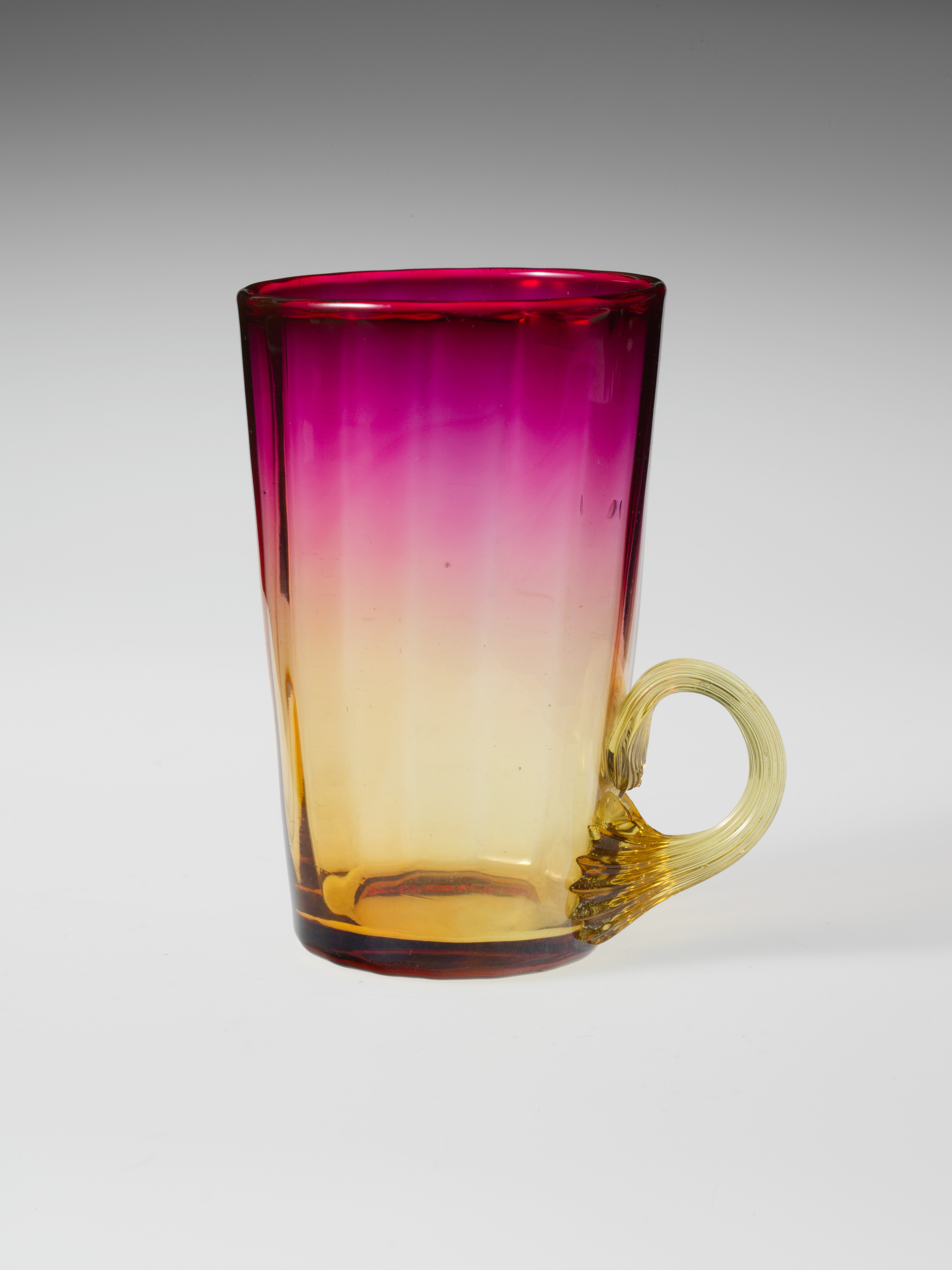
Punch Recipe

Punch Glass by New England Glass Company
Blown glass, circa 1883–88
Gift of Mrs. Emily Winthrop Miles, 1946
Metropolitan Museum of Art, New York
So far this spring, I've felt like a character in the 13-book set, A Series of Unfortunate Events. First I hurt my back and hobbled around with that for a couple weeks. Then I caught the worst cold and lingering cough that I've had in well over a decade. Then a tooth gave me all kinds of misery before I finally got it pulled.

And, most recently, a fellow from Tennessee rammed his 1995 Ford F150 truck into the back of my car.  Fortunately, I was not hurt. The accident did no damage to the truck, but damaged the trunk, bumper, and back corner of my car extensively. We are still waiting to hear whether his insurance company will fix it or total it.

All will be well. No condolences are necessary. Thank you for allowing me to whine.

Despite all, I managed to attend an estate sale and picked up an interesting little recipe book. The following recipe was handwritten and tucked inside. A comment at the top of the paper says this recipe is over 100 years old. Since it was obviously written down quite a few years ago, the recipe is surely 125 years old by now. One thing that the recipe doesn't really explain is that you need to have 3 quarts of water heating to a boil while you are simmering the spices.
Kentucky Spiced Tea
4 cups cold water
2 cups sugar
1 tsp. nutmeg
1 tsp. cloves
1 tsp. cinnamon
1 tsp. allspice
1/4 cup tea leaves
1/2 cup fresh orange juice
2/3 cup fresh lemon juice
12 cups (3 quarts) boiling water
Put sugar, COLD water, and spices (tied in a bag) in enamel or stainless steel boiler. Bring to a boil and boil for 10 minutes. Put in tea leaves (tied in a bag.) Add 12 cups BOILING water and juices. Steep for 5 minutes. Strain if desired. Chill. Serve each glass with a lemon slice skewered by a cinnamon stick.

Thursday, April 12, 2018

Just Give Me a Map

A young friend of mine posted a meme on Facebook today that read something like this, "Dad started pulling maps out of the glove box, but I was like, whoa, Indiana Jones! Just let me google it!"

It amused me and also got me thinking about map reading. I love my GPS, and Google maps on my cell phone is extremely convenient, but when I head into unfamiliar territory, I still like to look at a map and have a general picture in my mind of where I am headed.

Map of the world
!794 Samuel Dunn Map of the World
I would rank map-reading as one of the most useful skills I learned in school. What else is on the list? Reading, writing, and arithmetic, of course. And typing -- I can't imagine not knowing how to type. I give Miss Laberdy's Home Ec. class partial credit for teaching me basic sewing skills, along with my mother, 4-H, the Simplicity pattern company, and my own great desire for new clothes.

I don't credit Miss Laberdy with teaching me how to follow a recipe. I learned that long before I got to Home Ec., from my mother and 4-H. My high school didn't have drivers' education and didn't encourage girls to take shop classes, so I learned those life-skills elsewhere, too.

Back to map reading -- when I was in elementary school in the late 50s/early 60s, map-reading was part of Social Studies class.  I don't remember reading maps with the teacher very often, but we did have to write answers to the questions at the end of the chapters, and some of the questions always gave practice on map reading skills.

I got some real-life experience with map-reading on trips with my dad, usually either hauling cattle or going somewhere to look at cattle.  One Christmas, I made my mom and dad an orange felt envelope with the word "Maps" glued on it in brown felt letters.  They put it into service, and it saw a lot of miles. I smile when I think about that humble, child-stitched, felt packet of road maps.

As a young adult, it was empowering to have the ability to read a map and drive myself to new places. I discovered that the rules of map-reading applied to street maps as well as road maps, and city maps helped me find my way through cities on several continents.

When we moved here, I wore out my Christian County map, exploring new roads on summer afternoons with my kids. They were usually willing to participate -- they were game little troopers, my kids. Or, I'd get the Hopkinsville street map and the newspaper and plan a route for Saturday morning garage sales. And of course, going to Kansas and Missouri to visit our families has always required much map reading.  Because of maps and my insatiable curiosity about strange roads, I've taken every logical route there is through the Missouri Ozarks (and some illogical ones, too.)

Even with GPS and Google Maps on a smart phone, I don't like to go on a trip without paper maps or a road atlas in the vehicle.  I forgot to pack the maps when we drove out to Kansas a few years ago, and my daughter was quite upset with me. I was upset with me, too!  So we picked up some maps along the way.

Tuesday, April 3, 2018

Recent Rag Rugs

Rugmaking has become one of my great passions these last few years. These are a few of the rugs I made this last winter.  As always, you can click on these photos to enlarge them.

Crocheted rag rug in rainbow colors
Rag rug in rainbow colors

This rug has the colors of the rainbow -- ROY G. BIV (red, orange, yellow, green, blue, indigo, and violet.) It's a little weak in the orange and yellow section since I'm saving everything I have in those colors for kitchen rugs I'm making for my daughter-in-law next.

I experimented with several new-to-me techniques in this rug.  I used two narrow strips of fabric as the "yarn" throughout the rug, rather than a single strip like usual. This made the transitions from one color to the next easy.

Since the strips were an inch or less in width, I didn't attempt to fold in the raw edges as I usually do, so the rug surface is more thready than what I usually prefer.  I also joined the fabric strips by slit-knots, rather than sewing them together as usual. I don't think knotting is any faster than sewing (with the machine.) But I do see that it's easy to carry my rug-making with me whenever I leave the house, if I don't need sewed-together strips.

The two rugs at left, below, were made in my customary style -- fabric strips sewed together and raw edges turned in. These rugs reside on my daughter's back porch. The rug at right, below, includes remnants from the other two.  It was photographed in different light, but actually, it's a mate, more or less.  I gave it to my daughter as well.

I'm not sure why I was so determined to get rid of every scrap of those fabrics, but it seemed logical at the time. To me, these three rugs will always remind me of my husband's sinus surgery as that was the period of time in which I made them. I don't mean that they are sad rugs. My husband's sinus surgery was a great success, and he's feeling better than he has for a long time.

Green rag rugs
Two of a set of rag rugs
Oval rag rug with green, beige, and navy
The third rug of the set

Tuesday, March 27, 2018

Wolves and Bears in Trumbull County, Ohio

Early settlers in Trumbull County Ohio
Warren's location in Trumbull County, Ohio.
Wikipedia image.
My 6th great grandmother Mary (Bretta?) Lane, her husband Henry Lane, and her children from both her marriages, were among the first settlers of Warren in Trumbull County, Ohio. Mary's two sons from her first marriage, Caleb Jones (our ancestor) and Edward Jones,  arrived in 1799. Henry Lane brought Mary and the younger children in the spring of 1800. 

Mary is an ancestor on my father's side of the family. (Note to my kids: You remember that Almus Hill's mother was Mary Ann Jones. Mary Bretta was Mary Ann Jones's great grandmother, and her son Caleb Jones was Mary Ann Jones's grandfather.)

A small book, Early Settlement of Warren, Trumbull County, Ohio,  written in 1876 by Leonard Case, has quite a bit of information about the Lane family and other pioneers of the area. I thought the following description of the wolves was interesting.  This comes from pages 4-5.

   Wolves and bears committed depredations almost continually upon the cattle and hogs, and other smaller vermin upon the domestic fowls. The wolves would approach even within two rods [about 35 feet] of the cabin, seize a pig, run off with it and eat it, and as soon as the flock became still again, would return again and seize another in like manner; pursuing their depredations to such an extent as to render it difficult to raise anything.  The wolves would likewise seize and destroy the weaker cattle. In winter, when quite hungry, they were bold and would come among the settlers' cabins.
   The writer recollects one night in February, 1801, when the weather had been stormy-- the wind then blowing a severe gale-- when the wolves attacked the cattle on the Bottoms, on Lots 35 & 42 in Warren. The cattle gathered together in large numbers; the oxen and stronger ones endeavoring to defend the weaker ones. They ran, bellowing from one place to another and the wolves, trying to seize their prey, howled fearfully. In the morning, it was evident that the oxen had pitched at the wolves, burying their horns up to their sculls [sic] in the mud and earth. Several of the weaker cattle were found badly bitten.
   The bears preyed more upon the larger hogs; frequently carrying off alive some weighing as much as 150 pounds, though they preferred smaller ones.
   The foxes and other vermin so preyed upon the domestic fowls, that for some years it was difficult to keep any. That wolves prey upon sheep is usual wherever they exist in the same vicinity; but they were so bad about Trumbull, in its early settlement, that the settlers were unable to protect the sheep from the ravages of the wolves, for six or seven years.
Related:  I wrote about my 2nd great grandfather Almus Hill some years ago in my Prairie Bluestem blog. See "The Almus Hill-Almus Lentz Legend."

Wednesday, March 21, 2018

Brave Orpha Baker

I searched in old census records last night for any and all women named Orpha in Columbiana County, Ohio, and adjoining counties. As I was browsing,  I came across the 1840 census record for Orphie Baker and her family. That poor woman -- God rest her soul --was alone that year with eight children under the age of 20 in her home. I can only imagine the challenges she was facing when the census taker recorded this snapshot of her family.
Orphie Baker
Home in 1840:  Elkrun, Columbiana, Ohio
Free White Persons - Males - 5 thru 9:   2
Free White Persons - Males - 15 thru 19:   2
Free White Persons - Females - Under 5:   1
Free White Persons - Females - 5 thru 9:   1
Free White Persons - Females - 10 thru 14:   2
Free White Persons - Females - 40 thru 49:   1 (Orphie Baker)
Persons Employed in Agriculture:   2  (probably the two oldest boys)
Free White Persons - Under 20:  8
Free White Persons - 20 thru 49: 1
Total Free White Persons: 9
Total All Persons - Free White, Free Colored, Slaves: 9
"Winter Afternoon" by Claude Howell
Orpha's husband, Richard Baker, died in November of 1836, according to family trees that I viewed on Ancestry. What an awful time of the year to be left a widow.

Tax records for 1837 show that Orpha owned 50 acres valued at $101. Other Bakers lived in the same township, so I hope they were her husband's brothers and cousins and that they gave her the support of an extended family. She must have been thankful for her two oldest sons who could do the heaviest work on the farm.

Pondering this lady's situation, I wondered if she might have remarried before long. But I saw in the 1850 census that Orpha Baker was still on the farm alone and still raising her family. Of the eight children, seven were still with her. And in 1860, Orpha Baker was still on her farm with three unmarried adult children and a young child with a different surname. (I'm guessing that the child might have been an orphaned relative or a motherless grandchild.)

On FindAGrave, I learned that Orpha Chamberlain Baker died in 1865. Her tombstone is in rough shape, but I am glad that her family made sure she had one. May she rest in peace. May her descendants respect and honor her. And may she be an inspiration to all of us who think we're entitled to whine every time little things happen.

Published in the Cadiz Sentinel (Cadiz, Ohio), 14 Mar 1834
Vaguely related:
The Sudden Freeze of 1836 

Tuesday, March 20, 2018

Spring Snow

Spring snow
One of winter's last sputters
Light snow fell in Christian County today and continues this evening. A few minutes ago, I went outside with Sophie and saw that the cars' windshields are covered, but the sidewalks are still clear. The snow will be gone soon after it stops falling, as the temperatures are not quite cold enough to prevent it melting.

A Visit to the Dermotologist

Coal train near Trenton, KY
My receipt from the doctor -- and a coal train

Yesterday, I decided I could no longer postpone consulting a dermatologist about a mole on my face. So I called a doctor in Clarksville, and to my surprise, I got an appointment for 11:00 A.M. today. They had a cancellation, and I happened to call at the right moment.

I suppose the pending verdict on the mole was the reason I couldn't sleep last night. I wasn't consciously worrying, but I had extreme insomnia. At 4 AM, I looked at the clock and realized that in about three hours, the alarm was going to ring, sleep or no sleep. Sometime after that, I did drop off, and of course, I was sleeping very well when the alarm rang.

I found the doctor's office in Clarksville with no problem, and after half an hour of paperwork, and an hour of waiting in the reception area and in the examining room, I saw the doctor. She said the mole is a seborrheic keratose which is harmless, Since its itching is bothering me, she froze it with liquid nitrogen. I was thankful to have such a good diagnosis and quick treatment. I'm scheduled to see the doctor in ten weeks for a checkup and more cryosurgery, if necessary.

On the way home, I saw this coal train crossing Highway 181 south of Elkton.  My photograph, through the front window of my car, caught the reflection of my receipt from the doctor's office and superinposed it on the sky. It's sort of a symbol of my day.

Saturday, March 17, 2018

Sewist? Not Me!

Old Singer sewing machine and rug-making fabrics
Strips for a rag rug and my trusty Singer 99-K
I've become aware of the term, "sewist", since joining a couple of sewing groups on Facebook. "Sewists" object to describing themselves with traditional nouns like seamstress or tailor (too limiting and sexist) or sewer (too easily confused with a sewage drain.)

First, let's talk about sewers, the people who sew. Anyone with low-average or better reading skills should know the meaning and pronunciation of "sewer" by its context. If people truly are confusing you, a person who sews, with a sewage drain, it says something about them, not about you. Either they aren't native English speakers, or they're cruel, stupid, and/or ignorant.

Now, on to "sewist." I have an instinctive dislike of  "sewist", based on 66 years of speaking English as my native language. Here's why. In English, most words ending with -ist are built on nouns, like these: 
  • Therapy/therapist
  • Race/racist
  • Botany/botanist
  • Atheism/atheist 
  • Violin/violinist 
  • Bicycle/bicyclist
  • Colony/colonist
  • Hygiene/hygienist
  • Cartoon/cartoonist
  • Piano/pianist
  • Nutrition/nutritionist
  • And so on...

And then we have some words ending with -ist that are built on adjectives. A few examples:
  • Environmental/environmentalist
  • Real/realist
  • Federal/federalist
  • General/generalist
  • Special/Specialist
  • National/nationalist
  • And so on...

But English doesn't take verbs like "sew" and make them into nouns by adding "-ist." Every rule has its exceptions, but I can't think of even one example of that construction -- except for "sewist," if you want to call it a word.  (Update: the word typist has occurred to me, but type can be a noun as well as a verb, so it's not a perfect parallel to "sewist." Sew is always a verb.)

To test your instincts for the unwritten rules of the English language, here's a list of some verbs that can be made into nouns by adding a suffix.  Which would you choose? I hope this demonstrates why I think "sewist" is a silly, contrived word.
  • Own: owner or ownist? 
  • Rent: renter or rentist? 
  • Jog: jogger or joggist?
  • Make: maker or makist?
  • Use:  user or usist?
  • Run: runner or  runnist? 
  • Bake: baker or bakist? 
  • Preach: preacher or preachist? 
  • Talk: talker or talkist? 
  • Walk: walker or walkist? 
  • Write: writer or writist? 
  • Drive: driver or drivist? 
  • Employ: employer or employist? 
  • Clean: cleaner or cleanist? 
  • Serve: server or servist? 
  • Fight: fighter or fightist?
  • Wash: washer or washist? 
  • Build: builder or buildist?
  • Hate: hater or hatist?
  • Kill: killer or killist?
  • Dance: dancer or dancist?
  • Listen: listener or listenist?
  • Think: thinker or thinkist?
  • Observe: observer or observist?
  • Read: reader or readist?
  • Sell: seller or sellist? 
  • Teach:  teacher or teachist?  
  • Love: lover or lovist?
  • Plan: planner or plannist?

Let me be clear.  I don't like the word "sewist."  It looks and sounds unnatural and incorrect. But I'm not opposed to using an inclusive word for people (men or women) who sew as a hobby.  I think of myself as a fabrics crafter, because I like to sew, quilt, make rag rugs, collect fabric, etc. It's an inclusive term. Get some fabric and you can be a fabrics crafter, too.

And if you don't want to be a crafter, quilter, tailor, seamstress, or sewer, why not be a seamster? That's a genuine English word with a long and honorable history.

Monday, March 12, 2018

March Snows Remembered


Last week, we enjoyed some beautiful spring weather. On Thursday, I spent all afternoon transplanting some daylilies that are springing up where they ought not be. On Friday, another pleasantly warm day, I admired my work. (I was too sore to do much else. Apparently I am out of practice at standing with my head in front of my knees.)

Tonight, the weather has reverted to winter. The grass is crusted with snow. The wind is gusting, and the temperature is hovering at the freezing point. The roads are probably a bit slick in places. March is letting us know that it's a tricky month, able to spring a surprise anytime it wants.

In our 25 years in Kentucky, we've seen tornadoes in March. We've endured some terrible March ice storms.  And we've had some significant March snows.

The photo below was taken on March 5, 2015. The high that day was 25°, and the low was 6°. Brrrr! The snow was so deep that Sophie, our Basset Hound, had to stay in our tracks so she wouldn't get high-centered. I wrote on Facebook that day,
We got at least a foot of snow here at the house. It came with wind so it drifted pretty high in some places, but in the level areas, it measures 12 inches or more. Our kids, beside the Mississippi River in the SW corner of KY got more like 15 inches and also in the next county north of here, there are some reports of 20 inches. The bad thing is that under the snow there are a couple inches of sleet and ice.


Our Basset hound in deep snow
Sophie, our Basset Hound, and a March snow
Yep, that was a good one, March.  And here's another time you showed us what you can do!  On the evening of  March 7, 2008, our son Isaac and I had a memorable trip  through the snow. I got off work and scraped the snow off my car's windshield, then drove to Kroger and thawed Isaac's car. He got off work at 9 p.m., and we headed home through a swirl of snow. We couldn't tell where the lanes or the edges of the roads were, and when we turned off the highway onto the side roads, we had to bust snowdrifts.

The next morning, Isaac was supposed to be back at work, but he got stuck in our driveway. He called Kroger to let them know he was going to be late, and his manager accused him of inventing an excuse. The roads weren't bad in town, the manager said. I took this photo to help Isaac prove that it was different out in the country.

Drifted snow and a stuck car
Snow in March, 2008

Thursday, March 8, 2018

Tree Bark Powders at a Bulk Food Store


One of our local Mennonite bulk-food stores was selling these tree powders a few years ago. I don't recall seeing anything like this on their shelves recently. Maybe the tree bark powders did not sell well, or maybe their supplier doesn't carry them anymore.

According to Healthy Focus, white oak bark can be used as for its astringent,  antiseptic, or diuretic properties, for respiratory conditions or oral health, or externally for skin problems and wounds. They caution that white oak should not be taken more than 2 weeks at a time and that dosage recommendations should be followed carefully.

Black walnut powder has medicinal effects as well. Besides being a laxative, and astringent, it is also taken as an alterative (supposedly it alters a disease favorably). It's also used to treat tuberculosis --but please continue the TB treatment your doctor prescribed, and do not rely on black walnut powder! And black walnut can be used to treat a variety of skin conditions. Herbal Supplement Resource gives more information.

Women who are pregnant or nursing should never take an herbal remedy like a tree powder without their doctor's approval. And if you are taking other drugs or supplements, get your doctor's advice before beginning a tree powder treatment.

I don't recommend tree powders as a medicine in any way, shape, or form. I just thought it was interesting to see them for sale in a bulk-food store.

Monday, March 5, 2018

Eleanor Rigby, Rug Making Assistant

Here is little Eleanor Rugby -- umm, Eleanor Rigby, that is -- helping with my crochet project while I attend to other duties. I can count on her.

Eleanor Rigby in a rag rug
Eleanor at work with the crochet hook
Eleanor and I are making a second rug for my daughter's kitchen. It's a long runner, and I'm putting the final rows around the outside edge. It's a companion rug (related, but not identical) to this one.

Friday, March 2, 2018

Rag Rugs in a Little Contest

I love making rag rugs!  I do two types -- crocheted and twined -- and I participate in some Facebook groups for those crafts. Last month, Lora of Rags to Rugs by Lora saw a photo of a rug that I had posted on one of those groups and invited me to enter it into her monthly "Made by You" contest.

A brightly colored kitchen rag rug
My February entry won second place
I accepted the invitation, and guess what happened!  I didn't win first place and the prize of $25 of rag rug supplies, but I did win second place and the honor of having my rug displayed in Lora's 2018 hall of fame.

A few days ago, Lora contacted me and asked me if I had another rug to enter this month. I sent her a photo of a twined rug I made recently (photo below.)

I don't think I will win any recognition at all this month, because there are several absolutely gorgeous rugs! They make my little rug look pretty humble. But if you would like, you can visit  Lora's Facebook page and vote for me by clicking the "Like" button under the photo of my rug.

Blue twined rag rug
Please  visit this link and vote for my rug by clicking "Like" under the photo.

Popular Posts